



.jpg)
TL;DR: With a significant and growing portion of the U.S. construction workforce speaking languages other than English as their primary language, multilingual onboarding is no longer optional. The Occupational Safety and Health Administration (OSHA) requires workers to actually understand the information presented, not just receive it, and the penalties for falling short can reach $165,000 per violation. The workarounds most contractors rely on are inconsistent, unscalable, and unlikely to hold up under investigation. Digital construction safety software like Breadcrumb solves the multilingual onboarding bottleneck. It delivers standardized orientations with multilingual support, captures verified proof of comprehension, and cuts orientation time from hours to minutes without losing the human element.
Why Is Multilingual Onboarding Critical in Today’s Construction Industry?
Safety managers and superintendents across the United States face the same operational question every week. How do we get crews safely oriented and on the tools without losing half the day?
Under the OSHA act, site-specific orientation training is a requirement. Every worker must understand site-specific hazards, safety protocols, and emergency procedures before starting work. But as the U.S. construction workforce becomes more diverse, delivering that orientation effectively has become harder.
According to the National Hispanic Construction Alliance, Hispanic workers make up more than 30 percent of the U.S. construction workforce and fill close to 85 percent of trade and general labor roles. That share continues to grow.
At the same time, safety data highlights a concerning trend. CPWR – The Center for Construction Research and Training reports that fatalities among Hispanic construction workers more than doubled between 2011 and 2022, rising 107 percent to 408 deaths in 2022.
Multiple factors contribute to these outcomes. Communication gaps remain one of them.
Spanish is the most common non-English language on U.S. construction sites, but it is not the only one. Crews may include workers who speak Portuguese, French, Polish, or other languages. Even within Spanish-speaking teams, dialects and terminology vary.
Assuming one language will cover everyone is where preventable risk begins.
OSHA clearly states, “Employers must provide safety training in a language and vocabulary workers can understand.” This is a compliance requirement, not a recommendation. General contractors who fall short face regulatory exposure, particularly if an incident occurs and a worker can credibly claim they did not understand the orientation.
When contractors address the language gap and improve the onboarding experience, crews can start work more quickly and safely. Onboarding directly impacts productivity, serving as a control point that shapes the day's start.
What Does OSHA Require for Multilingual Safety Training?
Federal OSHA standards state employers must provide safety training in a language and vocabulary workers can understand.
If a worker does not comprehend English, instruction must be delivered in a language they do understand. If vocabulary is limited, training must reflect that. If workers are not literate, written materials alone do not satisfy the requirement.
Several OSHA standards reinforce this focus on comprehension. For example, Lockout Tagout rules require employers to verify that employees have acquired the necessary skills, and Respiratory Protection standards require retraining if gaps in understanding are identified. Other regulations require interactive question-and-answer opportunities during training sessions.
The expectation is not that information is presented. The expectation is that it is understood.
What Are the OSHA Penalties for Inadequate Multilingual Safety Training?
Failure to meet OSHA training requirements carries real financial consequences.
A serious violation can result in fines of up to $16,550 per violation. Willful or repeated violations can reach $165,514 per violation.
If a worker is injured and claims they did not understand the safety orientation due to language barriers, OSHA investigators will examine how training was delivered and whether comprehension was verified.
The costs extend well beyond the citation itself.
According to OSHA data, U.S. employers pay nearly $1 billion per week in direct workers’ compensation costs for disabling injuries, and that's before factoring in legal fees, rising insurance premiums, and the increased scrutiny that follows a serious incident.
Operations are likely to be halted while OSHA investigates. This leads to project delays and contractors will be forced to adjust the schedule and pay employees overtime to make up the time lost due to the stoppage.
Culturally, the fallout is just as damaging. A serious incident shakes employee morale, erodes crew confidence in site leadership, and can trigger turnover at the worst possible time.
Reputationally, word travels fast in the construction community, and owners and partners pay attention.
In an industry where margins are tight and timelines are critical, communication failures can quickly become operational liabilities.
Are Workarounds Undermining Multilingual Safety Orientations on Construction Sites?
Most U.S. contractors don’t ignore the language gap. They try to work around it. But the most common workarounds carry their own risks.
Relying on a bilingual crew member or foreman to translate on the fly is probably the most widespread approach. The problem with this is that translation is a skilled task. An untrained translator may paraphrase incorrectly, or struggle with the technical vocabulary that safety orientations require. Spanish dialects also vary significantly across Latin America, so the translation may not be 100% clear to the crew.
Google Translate and similar tools are quick but inconsistent. These tools have been known to make minor errors in tone and nuance. Even slight errors can mean the difference between a crew member who understands the hazard and one who does not.
Running the orientation twice in different languages solves the comprehension problem but makes orientation a time-consuming process and a drag on productivity.
A Safety Manager in the Midwest explained, “We’re almost 50–50 Spanish-speaking and English-speaking on site. If a subcontractor brings in 15 workers, we often have to run the same 30-minute orientation twice. By the time they watch the video, complete the test, and get cleared, it turns into a two-hour process for one crew.”
None of these approaches scales well, and none provide the consistent, documentable proof of comprehension that OSHA compliance requires.
How Can Digital Construction Safety Tools Support Diverse Workforces?
Digital construction safety software can aid in the field and improve the process of completing the safety orientation. They can help deliver orientations that every crew member understands, regardless of their native language.
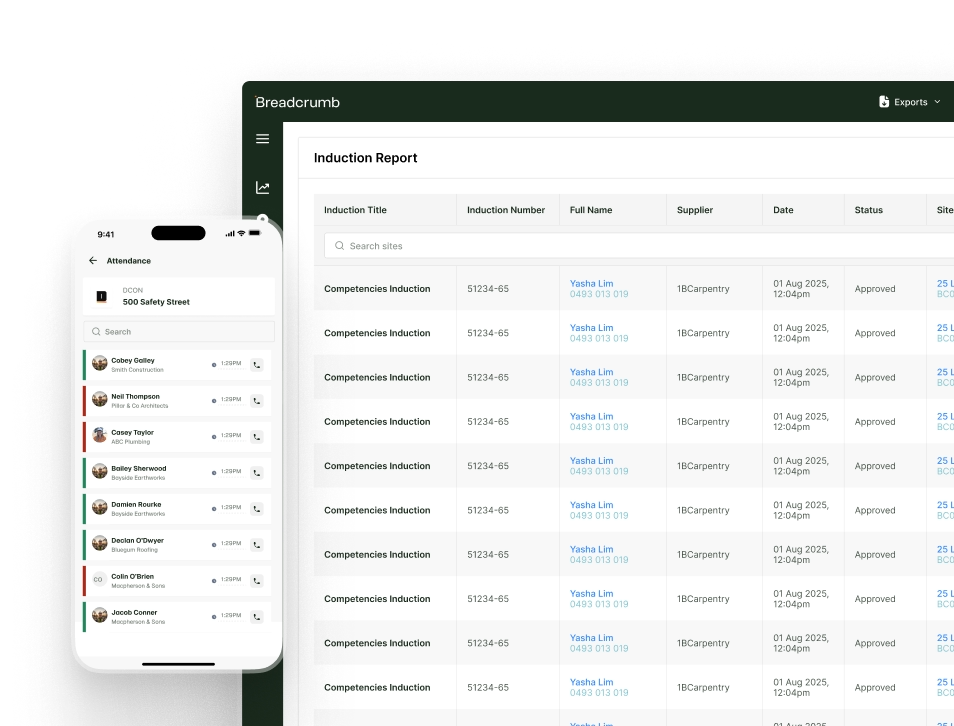
Breadcrumb, a simple site safety and compliance tool built specifically for construction, allows general contractors to deliver standardized safety orientations in multiple languages.
Workers complete the orientation digitally via QR code on-site or through a pre-sent link, with most orientations taking around 15 minutes depending on the contractor's requirements. Videos and media content can be hosted in multiple languages, so whether a crew is English or Spanish speaking, everyone is working from the same safety information. When sent in advance, workers arrive on-site already across the key information, leaving the site-specific briefing with the superintendent or safety manager to cover before they get to work.
“We recently used Breadcrumb to onboard a new subcontractor with a large, multilingual crew. The crew was fully oriented and working within 45 minutes, compared to nearly two hours it previously took to orient multilingual crews of this size," said Cole Dillon, Construction Safety Manager for Codaray Construction.
The compliance benefits are equally important.
Digital construction safety tools like Breadcrumb automatically capture digital signatures and timestamps for every completed orientation, creating an auditable trail that holds up to OSHA requirements. For contractors using project management platforms like Procore construction management software, orientations can sync automatically into a centralized document hub, eliminating the paper-chasing that typically accompanies compliance documentation.
For contractors managing multiple active sites, the ability to standardize multilingual orientations and engage workers across all of them is an operational advantage.
.png)
How Can Digital Construction Safety Software Promote Worker Engagement?
Traditional group orientations often struggle to hold attention. In large sessions, some workers disengage or are forced to move at a pace that does not match their experience level.
Digital orientations change that dynamic.
Staff and Safety Officer Jordon Stokes from Tepa observed the difference firsthand.
“With Breadcrumb I’ve noticed that when people go through the digital orientations on their phones, they’re able to go at their pace. It just engages them more and they can do it how they want to.”
Instead of sitting through a presentation that may over-explain familiar topics or move too quickly through new material, workers review the information themselves. That autonomy improves focus and retention.
Digital engagement does not stop at onboarding. Top 100 ENR contractor Brinkmann Constructors recognized early that any system adopted across diverse jobsites needed to work for everyone in the field. Since rolling out Breadcrumb, Brinkmann has seen strong engagement from field teams.
“One of the unexpected outcomes has been the amount of ideas and excitement that has come from our field teams. They’ve quickly identified the value and have continually developed new ideas for how the system can continue to help our teams,” said Jared Cox, Director of Project Controls at Brinkmann.
When safety information is easier to access, understand, and act on, engagement increases. And when engagement increases, safety becomes part of daily operations rather than a one-time requirement.
Can Your Current Onboarding Process Survive an OSHA Investigation?
The workarounds most contractors rely on don't meet OSHA's standard for verified comprehension. When an incident happens, investigators will ask exactly how understanding was confirmed, and "we had someone translate" is not always an answer that holds up.
Digital construction safety software closes that gap. Tools like Breadcrumb deliver multilingual orientations on any device and capture digital signatures and timestamps automatically. They also sync directly into platforms like Procore, creating an auditable compliance trail that holds up when it matters most. Orientation time drops from hours to minutes and documentation takes care of itself.
The language barrier is not a problem without a solution. It is a problem without an excuse. So the real question is not whether your onboarding process needs to change, but how much longer you can afford to wait before it does.
FAQs
Is multilingual safety training required by OSHA?
Yes. OSHA requires employers to provide safety training in a language and vocabulary workers can understand. If a worker does not comprehend English, training must be delivered in a language they understand. Simply presenting the material is not enough. Employers must ensure workers can reasonably comprehend and apply the information.
What are the OSHA penalties for failing to provide adequate safety training?
A serious OSHA violation can result in fines of up to $16,550 per violation. Willful or repeated violations can carry penalties of up to $165,514 per violation. In addition to fines, employers may face increased scrutiny, follow-up inspections, and legal exposure if inadequate training contributes to an incident.
Why is multilingual onboarding important in the U.S. construction industry?
More than 30 percent of the U.S. construction workforce identifies as Hispanic, and many jobsites include workers who speak Spanish or other languages as their primary language. Multilingual onboarding ensures workers understand site-specific hazards, safety protocols, and emergency procedures, reducing risk and improving compliance from day one.
How can digital construction safety software improve compliance?
Digital construction safety software like Breadcrumb standardizes the orientation process and creates a documented record of completion. Electronic signatures, timestamps, and centralized records help contractors demonstrate compliance during OSHA inspections. Putting digital orientations in the hands of workers also reduces reliance on informal translation and repeated group sessions.
How do digital safety tools improve worker engagement?
Digital construction safety tools like Breadcrumb allow workers to complete safety orientation at their own pace, often on their mobile device and in their preferred language. This improves focus and comprehension compared to traditional group presentations. When safety communication is clear, accessible, and documented, engagement increases and adherence improves across the life of the project.
Who is Breadcrumb for?
Breadcrumb is purchased by general contractors who want connected, collaborative, and compliant worksites. It is trusted by 1000+ contractors and used on 50,000+ projects worldwide.
How much does Breadcrumb cost?
Breadcrumb is priced annually, based on the size of your company. All feature updates and improvements are included at no extra cost.
built for the field.
