




The recent report from Deloitte and Autodesk - State of Digital Adoption in the Construction Industry 2026 - unpacked some alarming truths for the construction industry.
Based on over 954 construction and engineering businesses across Australia and five other Asia-Pacific markets, research found that only 16% of businesses have “advanced” digital capability. Fewer than half the businesses surveyed say their on-site teams have some form of real-time access to project data, and a quarter are still running mainly on paper.
What’s most concerning? 48% of the Australian construction workforce already use digital tools weekly, but Australian businesses still name a lack of digital skills, budget and confidence in the required technical capability as their three biggest barriers to going further.
More documentation or technology hasn't closed the gap between digital maturity and engagement of processes, because the industry's own research says the gap was never really about these things in the first place. It's about the people the documentation and technology depends on.
The easy read on all of this is that subbies don't care enough and that they're slow to change. They’re set in their ways. That's the attitude story, and it's wrong. Nobody signs up to be the reason a job stalls. What actually stops a subbie engaging with something like a compliance process isn't reluctance. It's that the process was never built to be reached from where they're standing and how they actually operate. That's not an attitude problem. That's an access problem: whether the process can actually be done from a phone without a login or a spare five minutes at a desk, not whether the person's willing to make the effort.
The problem with point-in-time paperwork and technology
Most Head Contractors already run a subcontractor compliance process. Sign in, induct, upload the SWMS, tick the box.
But what happens in those smaller moments that the process was never designed for? A subbie who's been on-site for six months and isn't sure whether his ticket expired last week. The Site Manager who finds out three projects too late that the workers never actually read the toolbox talk they signed off on. A HSEQ Manager who can produce every document WorkSafe could ask for, but can't say with certainty that any of it reflects what happened on site that day.
None of that is an attitude failure. It's an access failure, a gap between what the process assumes about a worker's day and how the site actually runs, not in the worker's willingness to participate.
Adoption is a change management problem before it's a technology one
So what actually solves this? You’d be safe to assume technology. You'd assume the answer is more technology. It isn't, not on its own.
Here's what most Head Contractors get wrong when they roll out a new tool. They treat it as a purchase, not a process. You buy the software, switch it on, and the job’s done. The businesses that actually get subcontractors and workers engaged treat it differently. They treat it more like a structured change, with the same discipline they'd apply to any other operational shift.
Show the team progress, not a promise of efficiency
A HSE and Risk Manager for a Head Contractor had that exact mentality when looking to implement a new software to improve their induction process. Before changing anything, his team timed the existing paper-based inspection: an eight-page, line-by-line compliance form, done fortnightly, taking seven and a half hours to complete. After digitising it with the new tool, the same inspection took 19 minutes a week.
"To get buy-in with the strategy, it's important to get some easy wins with low-hanging fruit,” they said. The change wasn’t sold on efficiency in the beginning. It was built on progress the team watched happen and participated in.
This scenario highlights that resistance often is never to do with the app or the tool in question, but more about how it works with the end user and how implementation done right improves engagement. Deloitte's own research backs this up with a significant number: construction businesses that run structured change management around a new tool (staff training, clear guidance, ongoing support), report weekly usage three times higher than businesses that skip it. The tool doesn't create the adoption. What happens around the tool does.
Address the real objection, which is trust, not technology
Ewi Stephens, HSEQ and ConTech Consultant, has seen the same concern surface whenever new construction technology is introduced: workers comparing digital site management tools to the tracking they already experience from Apple, Google and other technology providers, assuming their employer wants the same thing.
"The solution isn't a better sales pitch, it's transparency," he says. If you explain what information is collected, why it's required, who can access it, and when it stops, alongside a practical alternative like an on-site kiosk for workers who'd rather not use a personal device, you get engagement. Done properly, these platforms aren't about surveillance, they're compliance handled efficiently, freeing site teams to spend less time on paperwork and more time managing risk.
And the rollout itself doesn't have to run top-down. If you empower line managers, line managers then train end users, and by the time it reaches the workers, the people explaining the tool are their own supervisors, not head office.
Software doesn't close the gap on its own
Dominic Martens, Group Construction Technology manager for ICON, told Deloitte the biggest hurdle wasn't the software being implemented, it was those who preferred traditional, tactile ways of working, and who kept printing drawings and cross-checking versions by hand even after the platform was mandated. His fix wasn't a stricter mandate. It was patience: "overcoming the challenge is really about bringing people on the journey." That's not an attitude fix. It's an access fix - offering structured support until the new way is easier to reach than the old one.
None of this is unique to construction. It's the same pattern the safety researcher Gregory Smith described in Paper Safe, his study of how safety bureaucracy can drift away from actually protecting anyone. Smith explains that it "takes a lot more effort to provide clarity" than it does to simply prescribe a process and hope people follow it. A form that gets signed isn't the same as a worker who understood what they signed. Change management is the effort of closing that gap. Software doesn't close it by itself.
Access, not attitude, is what actually changes on site
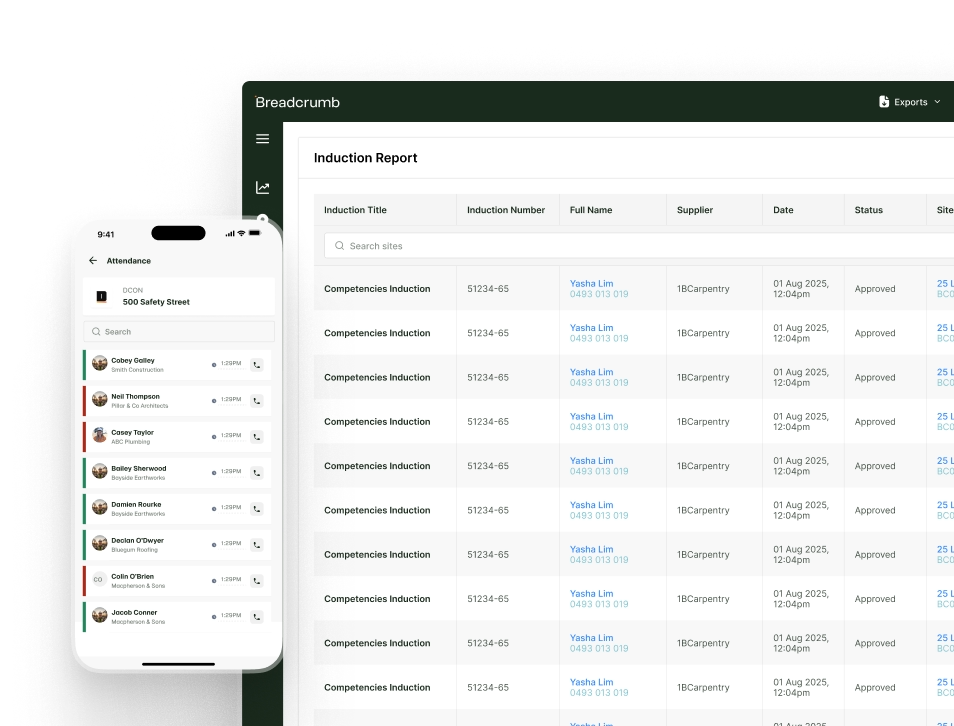
This is what solving an access problem looks like in practice - highlighting how fewer barriers between a worker and the process can look. Breadcrumb doesn't ask a subbie to learn a whole new system, it asks them to scan a code from a phone that's already in their pocket.
No login, no required app download. A worker can complete an induction on their phone the night before they arrive, and their licences, tickets and details carry across every project and every Head Contractor running Breadcrumb after that. The record updates itself because the worker is the one updating it, not because someone in the office is chasing them down.
Don Fowler, SHEQ Manager at JWLand, put it plainly when asked about the value real-time data can have when you know how to leverage it: "It helps give us a secure site from the turnstile stage to identify who's on site at any given time. In an emergency evacuation scenario, this app lets me send push notifications to everyone on site in an instant. That's critical for safety."
Damien Cavanough at Belmadar has watched the same shift happen on the ground when implementing Breadcrumb: "You get a lot of pushback with new technology with tradies who are set in their ways, but they have really come on board and seen the benefit of this software."
Every record Breadcrumb creates syncs straight into Procore, the system most Head Contractors are already running their projects through. The confidence doesn't live in a second, separate tool. It lives in the one they already trust. There’s a reason Breadcrumb is the most downloaded safety tool on the Procore Marketplace.
Why this matters more, not less, as a portfolio grows
One project can absorb a subcontractor who's fallen out of the loop. A portfolio of them can't.
As of October 2025, the construction workforce shortfall was at 141,000 workers. That number is projected to grow to 300,000 by mid-2027 according to the Infrastructure Australia's 2025 Market Capacity Report. 126,000 of that projected number accounts for tradespeople and labourers specifically. 59% of firms surveyed already rate labour and skills shortages a substantial threat to delivery. What this tells us is that when the workforce is this tight, a subcontractor who is not aligned with your processes isn't just a compliance risk. They're a retention risk, for you and for the industry.
Separately, Safe Work Australia's Key Work Health and Safety Statistics 2025 recorded 37 construction worker deaths in 2024, one in five workplace fatalities nationally, and ranked construction the second-highest industry for serious workers' compensation claims. That's the reality every HSEQ Manager is operating against.
At scale, a small gap becomes real exposure
At enterprise scale, the maths changes. Forty subcontractors across a dozen live projects means forty separate places a record can quietly stop matching reality, and forty separate places WorkSafe, an insurer or a client could ask a question the paperwork can't answer with certainty. Standardising how subcontractors are inducted, tracked and communicated with stops being an efficiency play at that point. It becomes risk management, and, per Deloitte's report, a revenue one too.
A construction business generating around $145 million in revenue (US$100 million in the report's own figures) that moves from “developing” to “advanced” digital capability is associated with roughly $160 million in additional revenue and $35 million in additional profit each year (US$111 million and US$24 million). Its more modest benchmark, a 10-point lift in digital capability score, roughly a two to three year ambition, is associated with around $26 million in additional revenue and $2.3 million in additional profit for the same business (US$18 million and US$1.6 million). None of that comes from a better attitude on site. It comes from removing what was standing between the worker and the process in the first place: the tools not built for how they operate.
Solve access, not attitude
Subcontractor engagement was never an attitude problem waiting for the right pep talk. It was an access problem waiting for a process that could actually reach the person doing the work. Solve access, and compliance stops being something you have to chase. It becomes the thing that happens on its own. When the process is effortless enough that workers barely notice they're complying, you get the outcome everyone wants.
built for the field.
